
At roughly 1:30 a.m., an apartment entry code no longer worked. Minutes later, a door had been damaged, two tires had been slashed, and a relationship had become evidence in court. By the time Lorraine Boone and Delano Seebaran appeared before Judge Judy, their breakup had produced not only property damage, but also a Facebook post that would become the second major dispute between them.
The episode then turned to a separate dispute: a trailer sold under a written “as is” agreement before it burned. Both hearings examined how assumption and responsibility can collide.

Case One : The Night an Argument Became a Lawsuit . A five-year relationship reaches a breaking point
Lorraine Boone and Delano Seebaran had been together for about five years. They had lived together on and off, and by August 19, 2024, they were sharing an apartment Lorraine said she had moved into independently. She testified that she had lived there for approximately a year. Delano contributed to rent from time to time and kept clothes there. They had no children together; Lorraine’s children, then 15 and 16, lived with her.

The evening began quietly. Lorraine worked from noon until 8 p.m., brought dinner home, and ate with her children. At about 10 p.m., Delano accused her of cheating after seeing a Facebook interaction in which someone appeared to call her “Bae.” An argument followed.
Lorraine left to cool off and walked around the block. Later, she received a text saying Delano was looking for her and would have
s-e-x with another woman before returning.
Her response was direct: stay where you are, do not come back, and expect the entry code to be changed. That decision would become central to the case.

The return at 1:30 a.m.
When Delano returned at approximately 1:30 a.m., the code no longer let him inside. Lorraine testified that he tried to force his way through the door by kicking it. She initially referred to changing the locks, but Judge Judy corrected the wording: Lorraine had changed the entry code, not the physical lock.
The distinction mattered because Delano had lived there for about a year, kept clothing there, and contributed to rent. Lorraine said that after the door resisted his efforts, he stabbed or slashed two tires on her car.
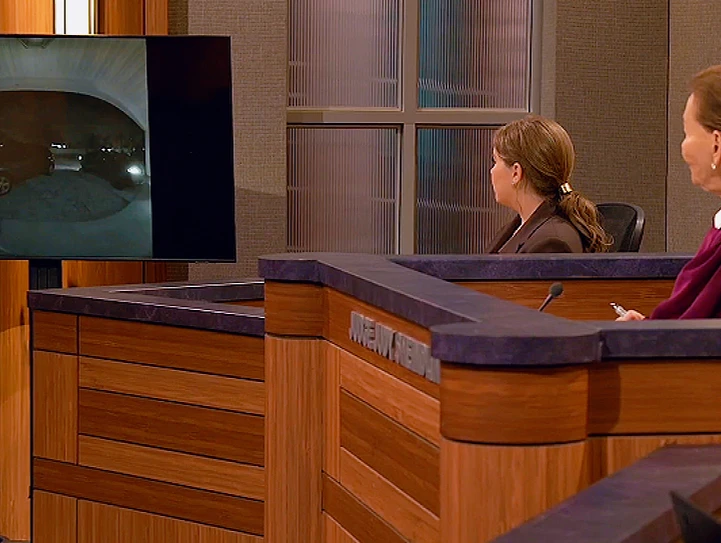
Lorraine did not see the tire damage happen with her own eyes. Instead, she testified that security cameras recorded Delano doing it. The courtroom viewed the footage, including banging, a rattling doorknob, and repeated kicks against the door. Delano acknowledged vandalizing the car and said he was upset after being locked out.
The cost of the tires—and the broken door
Lorraine said the two replacement tires cost $268.75 at Walmart. Installation added $64.50, bringing the stated total to $333.25. Judge Judy characterized the award as $333 and entered judgment for Lorraine on that property-damage claim.
The dispute did not end with the tires. Lorraine also presented photographs of the front door, which she said Delano’s kicking had split and left unable to open. Estimates of $564 and $897 were discussed, alongside her defamation claim.

When a Facebook Post Became Evidence
After the incident, Delano posted about Lorraine on Facebook. He admitted the post and said it remained online for approximately five minutes before he removed it. He explained that Lorraine had circulated the security video to his barber clients and that he had posted while angry. He also said he later texted her an apology for the post.
Lorraine disputed that he had called to apologize, but Judge Judy focused on the facts that could be established in court: Delano acknowledged publishing the post, acknowledged its insulting caption, and agreed that he removed it quickly. The caption referred to Lorraine as “one of the biggest hoes in Tampa.”

The judge drew a line between Lorraine’s circulation of the video and Delano’s accusation. The video, as presented in the hearing, supported what had happened to the car. Delano’s post, by contrast, made a degrading allegation about Lorraine’s character. Judge Judy explained that if a person makes a defamatory claim, being angry is not a substitute for proof. The fact that Delano removed the post almost immediately suggested that he recognized he had made a mistake.
The transcript first identifies $333 as the tire-related award. Later, after the door damage and defamation claim were discussed, Judge Judy announced a $907 judgment for Lorraine. The hearing does not provide a complete itemized breakdown of that later figure, so the safest reading is that $907 was the judgment ultimately entered after the additional claims were considered. The judge also reminded the parties that “pain and suffering” is not automatic in every small-claims dispute.

The Complication: Lorraine Could Not Simply Evict Him
The hearing did not portray Lorraine as legally correct. Judge Judy told her that changing the entry code to lock Delano out of a home where he had lived, kept clothes, and contributed to rent was against the law. If Lorraine felt threatened, the judge said, she could have contacted police for help.
That did not excuse Delano’s response. The judge described the kicking and tire damage as violent and foolish. Both sides were criticized for different choices: Lorraine’s attempt to protect herself and her children crossed a legal line, while Delano’s effort to regain entry by force created the liability that brought him to court.

Judgment and Aftermath
Judge Judy ruled for Lorraine and announced a $907 judgment after the additional claims were considered. The transcript separately identifies $333 for the tires, but does not itemize how the later $907 figure was calculated. Afterward, Lorraine said she was relieved to move on. She did not describe Delano as a bad person; she said he had his moments and hoped he would learn from the incident and take accountability. Delano likewise said he was glad the case was over and described Lorraine as a great person.
The post-hearing discussion treated the case as a cautionary account of escalation: the changed code transformed a cooling-off period into a confrontation, while the damaged property and Facebook post carried the relationship into court.

Case Two , and a Different Kind of Contract Dispute
Later in the episode, Jeffrey Shipley sued Heather Odegaard over a trailer sold for $3,500. The agreement called for a $500 down payment, $1,000 monthly installments, and a first payment due February 1. Testimony gave the purchase date as January 2 or 3, 2024, while Judge Judy later referred to the contract as dated January 1, 2024.

Heather moved in with her family. The signed contract described the Facebook Marketplace property as a fixer-upper sold “as is.” It burned on January 13. Heather argued that the fire was not her fault and that she believed Shipley had represented the trailer as at least in running condition.
Judge Judy focused on the written agreement, which twice identified the property as a fixer-upper sold as is. Heather could have inspected and insured it. The fire did not erase the purchase obligation, and the court awarded Shipley $3,500. A separate shed-and-belongings issue failed because there was no separate contract guaranteeing later retrieval.

What These Two Cases Showed
The cases turned on different evidence. In Boone v. Seebaran, camera footage and a social-media post shaped the dispute. In Shipley v. Odegaard, the decisive evidence was a signed “as is” contract.
Together, they offered the same lesson: emotional reactions do not replace lawful process, and verbal assumptions do not outweigh clear written terms. The first case called for police assistance rather than self-help; the second showed why business terms should be written down.
These were not stories of simple heroes and villains. They were disputes shaped by anger, fear, incomplete assumptions, and evidence that ultimately survived courtroom scrutiny.

FAQ
What happened in Boone v. Seebaran?
Lorraine Boone sued Delano Seebaran after an argument led to a changed apartment entry code, damage to the front door, slashed car tires, and a Facebook post about Boone. The transcript identifies $333 for the tires and later records a $907 judgment after the additional claims were considered, without giving a full itemized calculation.
How much did the damaged tires cost?
Boone testified that two tires cost $268.75 and installation cost $64.50. The court referred to the tire-related award as $333.
Did Lorraine Boone personally see Delano Seebaran slash the tires?
No. She said she did not see it personally, but security-camera footage recorded the incident and was shown in court.
Why was the Facebook post part of the lawsuit?
Seebaran admitted posting an insulting caption about Boone on Facebook. He said he removed it after about five minutes. The judge discussed the difference between a video that supported what happened and an unsupported defamatory allegation.
Was changing the apartment entry code legal?
Judge Judy told Boone that locking Seebaran out of a home where he had lived and contributed rent was against the law. The judge said Boone should have contacted police if she felt threatened.
Why did Heather Odegaard still have to pay for the burned trailer?
The signed contract described the trailer as a fixer-upper sold “as is.” Judge Judy ruled that the fire did not cancel Odegaard’s purchase obligation and awarded Shipley $3,500.